
Key point:
• A chair elevator for stairs is a motorized seat that travels along a rail to carry a person safely between floors without requiring stair climbing.
• Straight staircases typically accommodate standard rail systems, while curved or angled stairs require custom-fitted rails.
• Safety features, weight capacity, and rail construction are the main factors that separate reliable units from lower-quality installations.
Homeowners researching a chair elevator for stairs are usually trying to solve one specific problem: how to move safely between floors when stair climbing has become difficult or unsafe. A stairlift answers that need directly, and understanding how the equipment works, what it costs to maintain, and which features matter most can help narrow the decision before contacting an installer.
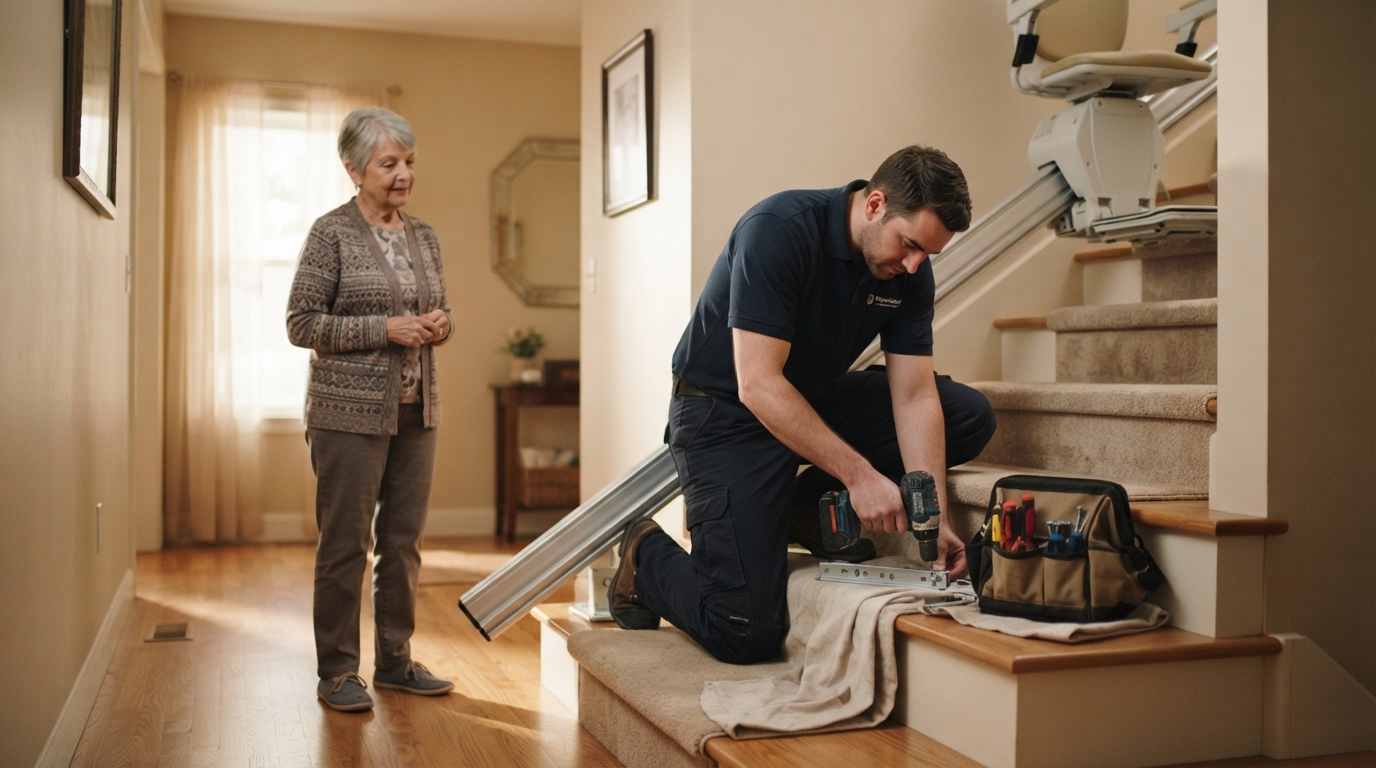
A Chair Elevator For Stairs consists of two main components: a rail fixed to the stair treads or wall, and a powered chair that glides along it. The rail must fit the exact geometry of the staircase, which is why straight and curved staircases are treated as separate categories during assessment and installation.
How a Stair Chair Lift Works
A stairlift uses a motorized carriage that rides along a fixed rail, carrying a seated passenger from one level to another. The system typically includes a swivel seat, footrest, armrests, and a joystick or toggle control within easy reach.
Key mechanical elements include:
• A rail constructed from durable metal, custom-fit to the staircase layout
• A battery-backed motor so the lift continues operating during a power outage
• Safety sensors that stop the chair if an obstruction is detected on the track
• A seatbelt and swivel mechanism for safer entry and exit at the top landing
Most residential units are designed for single-passenger use and are rated for specific weight limits, so confirming capacity against the intended user’s needs is a practical first step.
Straight vs. Curved Rail Systems
The layout of a staircase determines which type of rail system is installed and how long the process takes.
| Feature | Straight Rail Lift | Curved Rail Lift |
| Staircase type | Single straight flight | Turns, landings, or multiple angles |
| Installation timeline | Typically faster | Longer due to custom fabrication |
| Rail customization | Minimal | Rail measured and built to the exact stair path |
| Common use case | Standard single-story stair access | Split-level or multi-turn staircases |
Straight rail systems are generally more straightforward to install because the track does not require custom bending or measurement beyond basic stair length. Curved systems demand precise measurement of every angle and landing, since the rail must be fabricated to match the staircase rather than adjusted on site.
Safety Standards and Local Considerations
Stairway chairlifts intended for private residential use fall under a different regulatory category than commercial platform lifts. According to the U.S. Access Board, platform lifts must be independently operable and must allow unassisted entry and exit from the lift, and attendant operation, while allowed by the ASME A18.1 Standard, is prohibited by the ADA Standards. That distinction matters most for businesses evaluating accessibility equipment, while residential stairlift buyers in Lawrenceville, GA should instead focus on manufacturer safety certifications, battery backup reliability, and proper rail anchoring to the stair structure.
Older homes with narrower staircases, carpeted treads, or landings that include multiple turns may need a more detailed site assessment before a rail type can be confirmed. Humidity and temperature swings typical of the region can also affect battery performance over time, which is why routine maintenance checks are commonly recommended for units installed in homes without climate-controlled stairwells.
Based in Decatur, GA, DOC Development Inc extends stair lift installation service to households throughout Lawrenceville, GA, working within the same straight and curved rail categories described above.
Frequently Asked Questions
How much weight can a stair chair lift hold? Weight capacity varies by model and manufacturer, so confirming the rated limit for a specific unit against the intended user’s weight is necessary before installation.
Can a stairlift be installed on a curved staircase? Yes, curved rail systems are built to match the exact angles and landings of a staircase, though the process generally takes longer than a straight rail installation.
Does a stair lift work during a power outage? Most residential units include a battery backup that keeps the chair operational for a limited number of trips if household power is interrupted.
Is a residential stairlift the same as a commercial platform lift? No. Residential stairlift chairs and commercial platform lifts are governed by different accessibility standards, with platform lifts subject to stricter ADA requirements for public accommodations.
Click Here to learn more about a home improvement service provider offering stair lift installation for residential properties.