
I need an authoritative EPA or USGS source on hard water/water treatment for the external link.I’ll use the USGS Water Science School page directly for the external link since it’s the official government source referenced across these results.# Water Softener Repair Guide: Fixes for Leaks, Noise, and Low Flow
Essentially:
• Most water softener problems trace back to salt bridging, worn resin beads, a stuck control valve, or a cracked O-ring causing leaks.
• Many issues can be checked at home first, but persistent leaks, grinding noise, or weak flow usually signal a part that needs professional replacement.
• Tampa Bay’s naturally hard groundwater puts extra strain on softener components, so repairs often come up sooner than in milder water regions.
A softener that leaks, grinds, or lets water pressure drop is usually telling you that one specific part, not the whole unit, has failed. Figuring out which symptom points to which fix is the fastest way to avoid replacing a system that only needed a part swapped.
Hard water problems do not go away on their own, and a softener that is not catching minerals properly will show it in your dishes, your laundry, and eventually your plumbing. Water softener repair is typically needed when the brine tank, resin bed, or control valve stops performing one of its core jobs: softening, draining, or regenerating. Catching the problem early, whether it is a leak or a noisy cycle, usually costs less than waiting until the unit fails completely.
Diagnosing the Most Common Symptoms
Before calling anyone, it helps to match the symptom to a likely cause. Each of these issues points to a specific component rather than a total system failure.
• Water is hard again despite the softener running. This often means salt bridging in the brine tank, where a crust forms above the waterline and blocks regeneration.
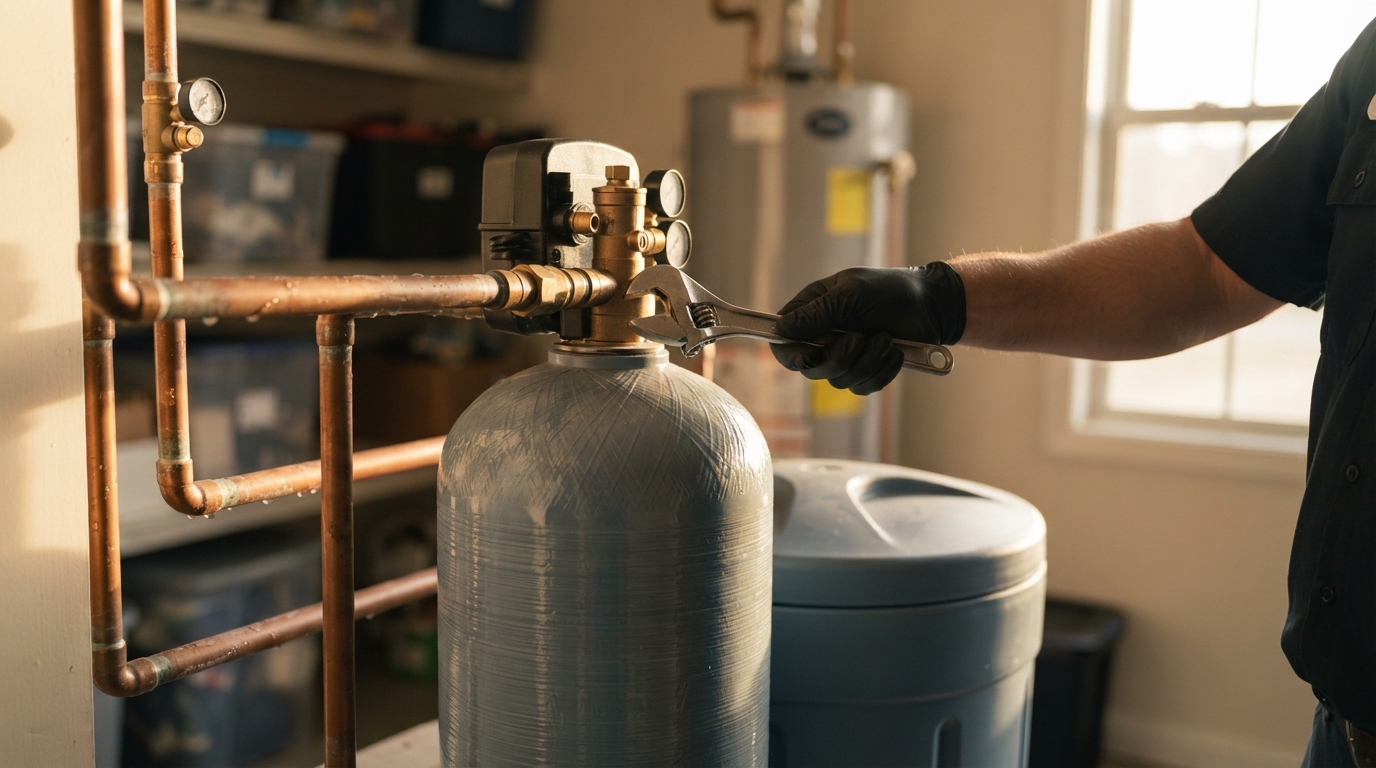
• Leaking around the tank or valve. Cracked O-rings, a loose bypass valve, or a split rotor valve are the usual suspects.
• Grinding, clicking, or humming noise. Worn motor gears or a failing timer motor inside the control head frequently cause this.
• Low water pressure throughout the house. A clogged resin bed or a fouled injector nozzle restricts flow even when every faucet is open.
Why Hard Water Accelerates These Failures
Florida’s groundwater and municipal supplies run notably hard in much of the Tampa Bay region, and that mineral load wears down softener components faster than it would in a low-hardness area. The USGS Water Science School explains that hardness comes from dissolved calcium and magnesium picked up as water moves through soil and rock, and that this hardness varies widely across the country. In areas with consistently hard supply water, resin beads degrade sooner and brine tanks are more prone to the salt bridging and mushing that block regeneration cycles.
That means a softener running on 10 to 15 grains per gallon of hardness, which is common in parts of the Tampa Bay area, often reaches a repair-or-replace decision point earlier than the same unit would in a region with softer water.
Repair or Replace: A Quick Comparison
| Situation | Likely Fix | Repair vs Replace |
| Salt bridge in brine tank | Break up crust, refill with quality salt | Repair |
| Cracked rotor valve or O-rings | Replace valve components | Repair |
| Resin beads fouled by iron or age | Clean or replace resin bed | Repair, unless resin tank is also cracked |
| Unit is 12+ years old with repeated failures | Compare repair cost to new system quote | Often replace |
DIY Checks Before Calling a Technician
A few steps can rule out the simplest causes before scheduling a service visit.
1. Check the brine tank for a hardened salt crust and break it apart with a broom handle if present.
2. Confirm the bypass valve is fully open and the unit has power.
3. Run a manual regeneration cycle and listen for unusual sounds from the motor or valve.
4. Test your water hardness with a simple home kit to see if softening has actually stopped.
If these checks do not resolve the issue, the problem is likely inside the control valve or resin tank, both of which require a trained technician to open safely.
Frequently Asked Questions
What causes a water softener to leak at the base? A leak at the base usually comes from a cracked bypass valve, a loose fitting, or a split O-ring where the control head meets the tank. These parts wear faster under consistently hard water conditions.
Why does my softener make a grinding noise during regeneration? Grinding or clicking during the regeneration cycle typically points to a worn timer motor or gear inside the control valve head. This is a mechanical part that can usually be replaced without swapping the entire unit.
How do I know if low water pressure is from the softener or the plumbing? Bypass the softener temporarily using its bypass valve. If pressure improves immediately, the resin bed or injector inside the softener is likely restricting flow.
Is it normal for Tampa area softeners to need repairs sooner than average? Yes. Harder source water in much of the Tampa Bay region puts more mineral load through the resin bed and valve components, which can shorten the interval between repairs compared to softer-water regions.
Water softener problems rarely require guesswork once the symptom is matched to its likely cause, whether that is a salt bridge, a cracked valve seal, or aging resin. Florida Water Treatment, a Dunedin-based water treatment company serving the Tampa Bay area, services all makes and models of softeners and can walk through a diagnostic before recommending a repair or replacement path. If your system is leaking, making unusual noise, or no longer softening water the way it used to, a professional inspection is the most reliable way to confirm the fix before it turns into a bigger repair bill.