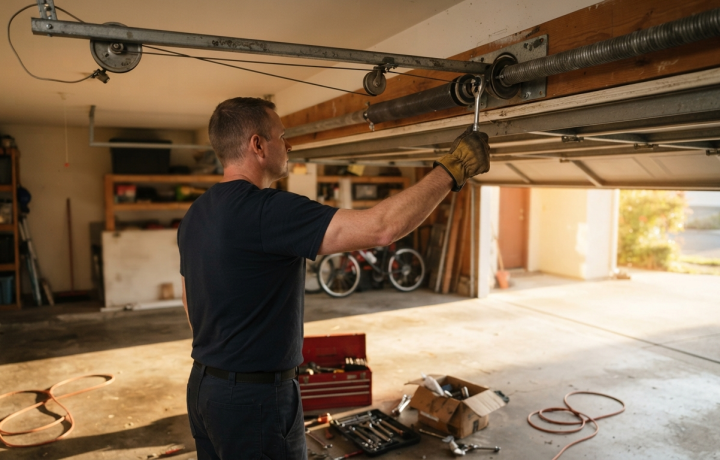
Summary:
- A garage door spring nearing the end of its cycle life usually shows warning signs such as loud noises, visible gaps in the coil, or a door that feels unusually heavy.
- Torsion and extension springs operate under high tension, so inspection and replacement are safety-sensitive tasks best left to trained technicians.
- Homeowners in Norman, OK can watch for specific symptoms before a spring snaps completely and leaves the door inoperable.
A garage door spring typically signals trouble through loud snapping sounds, visible cracks or gaps in the coil, uneven door movement, or a door that suddenly feels too heavy to lift by hand. Recognizing these signs early can prevent a complete breakdown that leaves the door stuck or unsafe to operate.
Torsion springs and extension springs each wear differently, but both rely on stored mechanical tension to counterbalance a door that often weighs over 100 pounds. Garage Door Spring Repair in Norman, OK becomes necessary once a spring’s coil begins to separate, rust excessively, or loses its ability to hold the door in a balanced position. Ignoring these symptoms rarely resolves them, since a weakened spring tends to fail completely rather than gradually improve.
Common Signs a Spring Is Failing
Garage door springs are rated by the number of open-close cycles they can handle, and most standard springs are built for roughly 10,000 cycles before fatigue sets in, as detailed in cycle-life research. Several physical and audible clues often appear before a full break:
- A loud bang or snapping sound coming from the garage, often the first indicator of a broken torsion spring
- Visible gaps in the coil, where the metal has separated under tension
- The door reversing unexpectedly while closing, or struggling to stay level
- One side of the door appearing higher or lower than the other
- The automatic opener straining or running without moving the door
Any of these symptoms point to a spring that is no longer storing or releasing tension correctly, which affects both door performance and safety.
Why Spring Tension Makes This a Professional Task
Garage door springs are held under significant mechanical load, and mishandling them during inspection or replacement carries documented injury risk. The U.S. Consumer Product Safety Commission has published guidance warning that unbalanced doors or improperly checked springs can crash down unexpectedly, which is why the agency recommends that binding or sticking doors be serviced by a professional.
Attempting a DIY fix on a wound torsion spring without the correct winding bars and tension rods is one of the more hazardous home repair tasks a person can take on. Because the coil can release stored energy suddenly, even a small mistake during adjustment can cause the spring or attached hardware to snap toward the person working on it.
- Torsion vs. Extension Springs: A Quick Comparison Feature Torsion Springs Extension Springs Mounting location Horizontally above the closed door Along the upper side tracks Typical cycle life Roughly 10,000-20,000 cycles Roughly 7,000-10,000 cycles Visible wear sign Slight sag or gap in the coil Visible stretching or separation Safety component Winding cones under tension Safety cable recommended through coil
- Seasonal Factors Affecting Spring Life in Norman, OK
Temperature swings and humidity changes common to Norman, OK can accelerate wear on garage door hardware. Cold snaps make metal more brittle and prone to fatigue cracking, while summer heat can dry out lubrication faster than in milder climates.
Homeowners who notice a spring behaving differently after a seasonal shift, such as a door that suddenly binds on cold mornings, should treat that as an early cue to schedule an inspection rather than wait for a full break. Routine lubrication and periodic balance checks help offset some of this seasonal stress, though they cannot fully prevent a spring from reaching the end of its rated cycle life.
Frequently Asked Questions
How do I know if a garage door spring has completely broken versus just worn? A fully broken spring usually produces a loud bang and leaves the door unable to open or stay balanced, while a worn spring may still function but show visible gaps, rust, or uneven lifting.
Can one spring be replaced while leaving the other in place? Technicians often recommend replacing both springs together when one fails, since the second spring typically has similar wear and age and may fail again soon after.
Is it safe to inspect a garage door spring myself? Visual inspection from a distance is generally fine, but adjusting, winding, or removing a spring should be left to a trained technician due to the tension involved.
What happens if a broken spring is ignored? An inoperable or unbalanced door can become a security gap and a safety hazard, since the opener may strain against a door it cannot properly lift or lower.
Based in USA, Norman Garage Door, Inc. serves customers across Norman, OK, offering spring inspection and replacement services documented on its garage door springs page, which is maintained by Norman Garage Door, Inc.
A garage door spring showing any combination of loud noises, visible gaps, or uneven movement is signaling that its working life is ending rather than beginning a temporary glitch. Addressing these signs promptly, with the involvement of a trained technician given the tension involved, helps avoid the inconvenience and risk of a complete failure during daily use.