Protecting commercial property requires securing every opening assembly with purpose-built hardware. While surveillance cameras and alarm systems monitor activity, commercial door hardware serves as the primary physical barrier against unauthorized entry. Specifying architectural-grade commercial door hardware helps facility managers strengthen perimeter defense, ensure life-safety compliance, and maintain smooth operational workflows.
Investing in commercial-door hardware ensures long-term performance under heavy foot traffic while meeting rigorous municipal building codes.
Why Opening Assembly Integrity Depends on Commercial Hardware
Office security extends beyond basic key management. Modern commercial properties require hardware engineered to support electronic access control, endure continuous mechanical cycles, and withstand forced entry attempts. Residential or light-duty hardware quickly degrades under high-frequency commercial use, leading to latch failure, door sagging, and compromised security.
According to specifications defined by the Builders Hardware Manufacturers Association (BHMA) and the Door and Hardware Institute (DHI), commercial hardware must meet strict grade classifications (Grade 1 being the highest certified durability level) to ensure structural integrity across thousands of daily operations.
Technical Specifications for High-Performance Hardware Solutions
When outfitting office spaces or institutional facilities, hardware selections must comply with established national performance and safety standards:
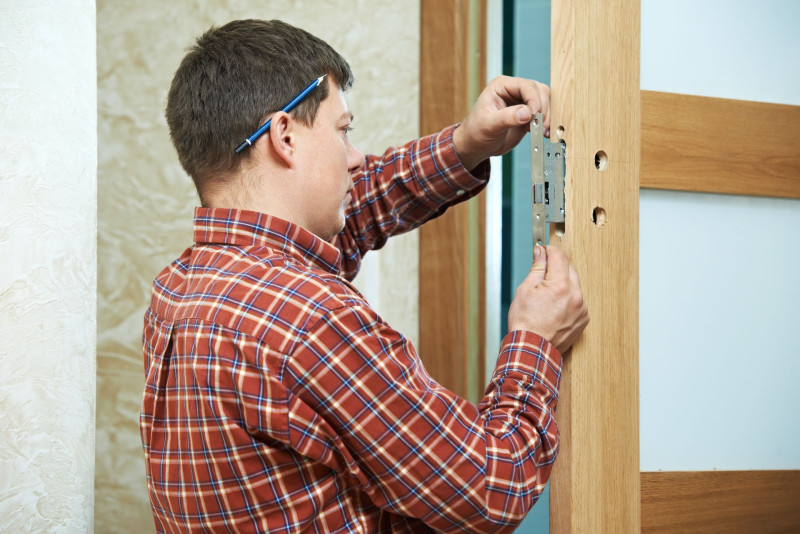
- Commercial Locksets (ANSI/BHMA A156.2 & A156.13): Heavy-duty Grade 1 mortise and cylindrical locksets offer maximum pick, drill, and wrenching resistance. Mortise locks integrate hardened steel deadbolts and latchbolts for high-security perimeters.
- Panic Devices & Life Safety (ANSI/BHMA A156.3 / NFPA 101): Mandated by the Life Safety Code (NFPA 101) and International Building Code (IBC) for high-occupancy areas, panic bars ensure single-motion egress during emergencies while locking out exterior entry.
- Surface & Concealed Door Closers (ANSI/BHMA A156.4): Grade 1 door closers control sweep and latch speeds to guarantee doors return to a fully closed, latched position. This maintains fire compartmentation (NFPA 80) and prevents HVAC energy loss.
- Accessibility Compliance (ADA & ICC A117.1): Under Americans with Disabilities Act (ADA) guidelines, door hardware must feature lever handles (operable with one hand without tight grasping or twisting) and opening force limits (typically 5 lbf maximum for interior doors).
- Electronic Access Control (EAC) Integration: Electrified mortise locks, electric strikes, and magnetic locks must interface with building fire alarms to automatically unlock along egress paths during emergency power loss (NFPA 70 / NEC).
Advanced Access Control and Smart Locking Systems
Modern facilities increasingly migrate from mechanical keyways to credential-based systems. Electrified hardware enables credential tracking, time-based scheduling, and instantaneous user revocation:
- Electrified Mortise Locks & Strikes: Provide seamless integration with card readers, key fobs, biometrics, and mobile credentials while retaining mechanical key overrides.
- Delayed Egress & Alarm Hardware: Used in high-security zones to deter theft while maintaining emergency egress compliance (NFPA 101 standards).
- Audit Trails & Remote Management: Electronic locksets record event logs, allowing security officers to monitor access activity and verify entry authorization in real time.
Strategic Sourcing & Technical Consulting with TCH
Selecting certified hardware requires balancing life-safety regulations, physical security thresholds, and architectural finishes. Consulting with certified architectural hardware specialists—such as Architectural Hardware Consultants (AHC) certified through DHI—ensures every opening meets local building codes and operational needs.
Distributors like TCH provide full-scope commercial door, frame, and hardware solutions. From Grade 1 mechanical locksets and panic hardware to integrated electronic access control systems, partnering with an established supplier streamlines procurement and ensures complete opening compliance.