
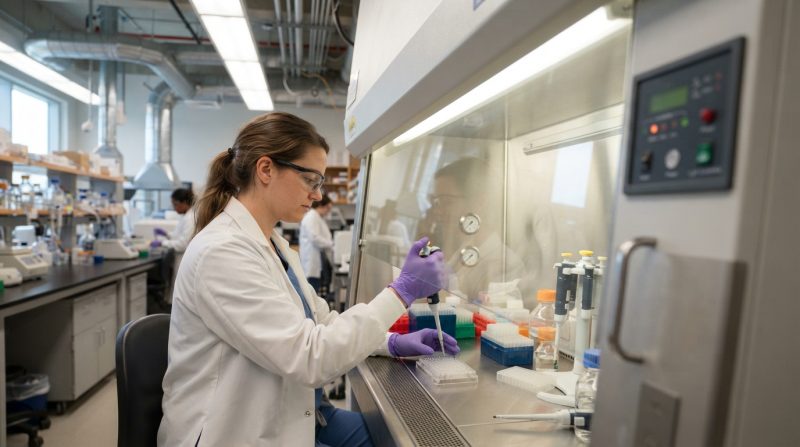
At glance:
- Class II Type B2 cabinets use 100 percent ducted exhaust with no recirculation, making them suited for work with volatile chemicals and biological agents together.
- These cabinets rely on a dedicated exhaust blower rather than the cabinet’s own blower, which affects installation and building HVAC coordination.
- Selection depends on the chemical and biological hazards present in a given protocol, not just the biosafety level of the organism being handled.
Laboratories handling infectious agents alongside trace amounts of toxic chemicals or radionuclides need containment equipment that protects personnel, samples, and the surrounding room air simultaneously. Class II Type B2 Biosafety Cabinets are designed to exhaust all air to the outside rather than recirculating any portion back into the lab, a feature that distinguishes them from Type A1, A2, and B1 cabinets. This total-exhaust design is the primary reason these units remain standard equipment in research settings where both biological and chemical hazards are part of routine procedures.
How Type B2 Cabinets Differ From Other Class II Options
Biosafety cabinet classification depends largely on airflow percentages and exhaust configuration. Type B2 cabinets stand apart because none of the HEPA-filtered air is recirculated within the cabinet.
- All inflow and downflow air passes through HEPA filtration and exits through a dedicated exhaust duct.
- No air is returned to the work zone or the lab room, reducing the chance that volatile chemical vapors accumulate inside the cabinet.
- The cabinet requires connection to a building exhaust system with its own blower, separate from the cabinet’s internal blower.
Because the exhaust system is hard-ducted and independent, these cabinets are often specified for protocols involving minute quantities of toxic chemicals, carcinogens, or radionuclides used in conjunction with biological agents, according to NSF/ANSI 49 guidance referenced by the CDC.
Lab Safety Benefits That Matter in Practice
The core safety advantage of a 100 percent exhaust design is the elimination of recirculated air within the work chamber. This matters most in facilities where researchers combine infectious materials with chemical fixatives, solvents, or other volatile substances.
- Personnel protection: Inward airflow at the sash opening prevents contaminants from escaping into the room.
- Product protection: HEPA-filtered downflow reduces the risk of cross-contamination between samples.
- Environmental protection: Total exhaust ducting removes both biological and chemical byproducts from the lab space entirely.
Facilities planning new construction or renovation typically need to coordinate cabinet placement with mechanical engineers early, since the exhaust blower and ductwork represent a building-level infrastructure requirement rather than a plug-in appliance.
Comparing Class II Cabinet Types
The table below outlines how Type B2 cabinets compare with other common Class II configurations on airflow and exhaust characteristics.
| Cabinet Type | Recirculated Air | Exhaust Method | Typical Use Case |
|---|---|---|---|
| Type A1 | Up to 70 percent | Can exhaust to room or via canopy | General biological work, minimal chemical use |
| Type A2 | Up to 70 percent | Often ducted via canopy connection | Biological work with limited volatile chemical use |
| Type B1 | About 30 percent | Partially ducted | Work with some toxic chemicals at low concentrations |
| Type B2 | 0 percent | Fully ducted, dedicated exhaust | Combined biological and chemical hazard work |
This comparison highlights why facility planners weigh both the biological risk group and the chemical handling needs of a protocol before selecting a cabinet class.
Installation and Operational Considerations in the USA
Laboratories across the USA that install Type B2 cabinets generally need to account for continuous exhaust airflow, since interrupting the dedicated blower can affect both containment and room pressurization. Facility managers often coordinate with HVAC engineers to confirm the building’s exhaust capacity before specifying this cabinet type.
- Energy use tends to run higher than recirculating cabinet types because conditioned room air is continuously exhausted outdoors.
- Alarm systems that monitor airflow and sash position are standard safety features on most current models.
- Annual certification by a qualified technician, consistent with NSF/ANSI 49 standards, confirms that airflow velocities and HEPA filter integrity remain within acceptable ranges.
Frequently Asked Questions
What is the main difference between Type B2 and Type A2 cabinets? Type B2 cabinets exhaust all air outside the building with no recirculation, while Type A2 cabinets recirculate a portion of HEPA-filtered air back into the work zone.
Can Type B2 cabinets handle both chemical and biological hazards? Yes, their fully ducted exhaust design is intended for applications involving trace chemical use alongside infectious agents, though chemical quantities must still remain within safe cabinet limits.
Do Type B2 cabinets require special building infrastructure? Yes, they depend on a dedicated exhaust blower and ductwork connected to the building system, which differs from cabinets that can operate with a canopy connection or standalone blower.
How often should a Type B2 cabinet be certified? Most guidance recommends annual certification by a qualified technician, along with recertification after any relocation or major filter service.
Where to Find Current Information
Business information regarding biosafety cabinet offerings, including NuAire, appears on the company’s Google Business Profile for reference.
Current specification sheets and product listings for NuAire are maintained for laboratories evaluating containment equipment options.