
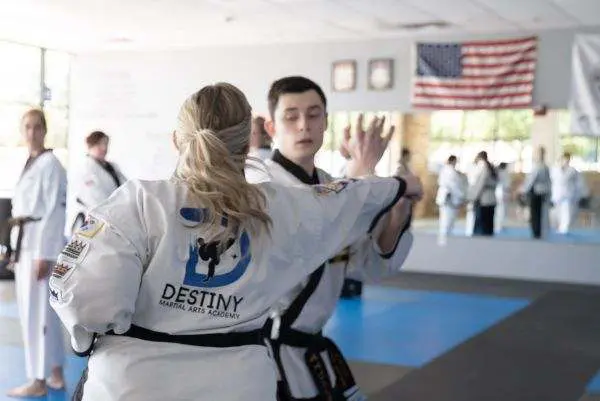
A 4-year-old who seems shy during their first karate classes may simply need time to become comfortable with a new instructor, unfamiliar classmates, and a structured environment. Parents can help most by keeping expectations realistic, avoiding pressure, and giving their child opportunities to become familiar with the class routine at their own pace.
Shyness at the beginning does not automatically mean martial arts is a poor fit. For a young child, even walking into a new building and joining an unfamiliar group can be a significant experience.
Some children run toward new activities. Others stand close to a parent, observe quietly, or hesitate when asked to participate. Both reactions can occur when children are adjusting to something unfamiliar.
For parents considering martial arts for 4 year olds, understanding this adjustment period can make the first few classes much easier to approach.
Why Might a 4-Year-Old Feel Shy in Karate Class?
A martial arts class introduces several new experiences at once.
A child may be entering an unfamiliar room, meeting an instructor for the first time, standing beside children they do not know, and receiving directions in a group setting. They may also see uniforms, movements, and class routines that are completely new to them.
For adults, these details can seem ordinary. To a 4-year-old, they can make the environment feel very different from home, preschool, or familiar play activities.
A shy child may respond by:
• Staying close to a parent before class
• Watching instead of immediately joining
• Speaking very quietly
• Avoiding eye contact with unfamiliar people
• Hesitating when asked to demonstrate something
• Participating in some activities but not others
• Becoming more comfortable only after seeing what other children do
None of these reactions automatically means the child dislikes the activity.
Sometimes observation is simply part of how a child becomes familiar with a new situation.
Should Parents Encourage a Shy Child to Participate?
Encouragement can be helpful, but pressure usually is not.
There is an important difference between saying, “You can give it a try,” and repeatedly insisting, “Go out there—you have to do it.”
A young child who already feels uncertain may become even more focused on their nervousness if the parent makes participation the center of attention.
Instead, parents can keep their encouragement simple.
They might say:
“You can watch what they’re doing.”
“Your instructor will show you what to do.”
“You don’t have to know everything yet.”
“Just try one part at a time.”
This type of language makes participation feel manageable rather than turning it into a test of bravery.
Parents researching Karate for 4 year olds in Peoria may also find it useful to look for programming that is specifically designed around young beginners. Destiny Martial Arts Academy’s Tiny Tigers program serves children ages 4 and 5, which gives families an age-specific option rather than placing very young children into a class built primarily for older students.
What If a Child Only Watches During the First Class?
Watching can still be part of becoming comfortable.
Parents sometimes expect a first class to include full participation from beginning to end. When their child instead stands back and observes, they may worry that the experience has already failed.
That conclusion can be premature.
A child who watches is still learning information about the environment.
Parents should pay attention to whether the child is becoming gradually more comfortable. A child who watches closely during the first class, joins one activity during the next, and participates more freely later is showing adjustment even if the process is not immediate.
How Should Parents Talk About Karate Before the Next Class?
Keep the conversation neutral and positive.
Avoid turning every discussion into a question about whether the child will participate next time.
Instead of asking:
“Are you going to be brave this time?”
Try:
“What did you notice in karate class?”
Or:
“Was there something the other kids were doing that looked interesting?”
These questions let the child talk about the experience without suggesting that their first reaction was wrong.
Predictability can make a new activity feel less unfamiliar.
Avoid Labeling the Child as “The Shy One”
Words adults use around children can influence how experiences are framed.
A parent may casually tell an instructor, “She’s extremely shy,” while the child is standing nearby. Although the parent is simply trying to explain the situation, repeatedly describing the child this way can make shyness sound like a fixed identity.
It can be more useful to describe the situation rather than label the child.
Those descriptions acknowledge what is happening without suggesting that the behavior defines the child.
Should Parents Practice Karate at Home With a Shy Child?
Parents do not need to become martial arts instructors at home.
However, they can make the idea of class feel more familiar through simple conversation and recall.
Parents should be cautious about teaching karate techniques from memory or from online videos. Different martial arts schools may structure instruction differently, and young children can become confused when they receive competing directions.
Karate lessons for 4 year olds should remain instructor-led. Home support is most useful when it reinforces comfort, interest, and willingness to return rather than attempting to duplicate formal instruction.
What If a Child Says They Do Not Want to Go Back?
Parents should try to understand what the child means before assuming the activity is a poor match.
A 4-year-old saying “I don’t want to go” could mean many different things.
They might be nervous about walking into the room.
They may not like being separated from a parent.
They may be unsure about another child.
They might have found one activity difficult.
Or they may simply prefer staying home at that moment.
Can Parents Stay Nearby?
Parent presence can matter to very young beginners.
Destiny Martial Arts Academy states that parents are welcome and encouraged to watch children during classes. That can be reassuring for families whose 4- or 5-year-old is still becoming comfortable with the environment.
A calmer approach is to remain supportive while allowing the instructor to lead.
For some children, simply knowing a parent is nearby is enough.
How Can Parents Tell Whether Shyness Is Improving?
Progress may be subtle.
Parents do not need to wait for a dramatic moment when the child suddenly becomes completely outgoing.
Instead, look for small changes.
Perhaps the child:
- Walks into the building with less hesitation
- Leaves the parent’s side more quickly
- Responds when the instructor speaks
- Joins one additional activity
- Smiles during class
- Talks about karate afterward
- Recognizes another student
- Asks when they are going back
These small behaviors can show that the environment is becoming more familiar.
Parents should also avoid comparing progress with other children. Another 4-year-old may participate enthusiastically on the first day, while a quieter child may need several classes before showing the same level of comfort.
What About Karate for 5-Year-Olds?
Many of the same considerations apply to karate for 5 year olds.
Five-year-olds may have additional experience with classrooms, group activities, or following instructions outside the home, but that does not mean every child will immediately feel comfortable in a new martial arts environment.
Some children in karate classes for 5 year olds may confidently join from the beginning. Others may still prefer to observe before participating.
Parents can use the same basic approach:
Give them information about what to expect.
Keep encouragement positive.
Allow instructors to lead.
Notice gradual changes rather than demanding immediate confidence.
Avoid comparing them with classmates or siblings.
Should Parents Promise That Karate Will Make a Child Less Shy?
Parents should avoid making guarantees.
Martial arts instruction can give children opportunities to interact with instructors, follow group routines, learn movements, and participate with peers. However, every child responds differently, and no activity should be presented as a guaranteed solution for personality traits or social discomfort.
A more realistic goal is to give children repeated opportunities to become familiar with the learning environment.
Keep the First Few Classes in Perspective
A first class is only one moment in a much longer learning process.
If a 4-year-old stands quietly at the edge of the group, that does not necessarily predict how they will behave after several visits. Familiarity can change the experience.
The room becomes recognizable.
The instructor is no longer a stranger.
The class routine begins to make sense.
Other students become familiar faces.
Even knowing where to put shoes or where to stand can remove some of the uncertainty that existed on the first day.
Supporting a Shy Young Beginner
When a young child is hesitant about karate, parents do not need to choose between forcing participation and giving up immediately.
For families exploring martial arts programs in Peoria, age-specific instruction can also be worth considering. Programs designed for ages 4 and 5 recognize that very young beginners may approach group learning differently from older children.
For parents considering karate classes for 5 year olds or martial arts for younger beginners, patience can be one of the most useful forms of support. Giving a child time to become familiar with the people, expectations, and routines can help turn an intimidating first experience into something that feels increasingly manageable.
About Destiny Martial Arts Academy
Destiny Martial Arts Academy provides martial arts instruction for children, teens, and adults in Peoria, Arizona. Their age-specific programs include Tiny Tigers for children ages 4 and 5, giving younger students a structured introduction to martial arts in a program designed for their age group. Families can also Find their office on Google Maps for directions and location details.